


The 16 Myers-Briggs (MBTI) personality types can seem overwhelming. But you don't need to be an expert to use its principles to improve your work relationships. The key is to stop trying to guess someone's 4-letter type and instead learn to spot their preferences for the four key dichotomies. This guide will teach you how to observe those preferences and then engage effectively with the four major workplace temperaments.
Part 1: Spotting the Four MBTI Preferences
Focus on these four pairs of preferences to decode your colleagues' operating systems.
1. Energy Source: Extraversion (E) vs. Introversion (I)
This is about where people get their energy. Do they charge up by being around others or by being alone?
-
Spotting Extraversion (E):
-
Obvious Signs: They "think out loud," often processing ideas by talking them through. They are energised and expressive in group meetings and social gatherings.
-
Subtle Nuances: They prefer to kick off a project with a group brainstorm. They are more likely to pick up the phone than send an email. They often have a wide network of colleagues.
-
-
Spotting Introversion (I):
-
Obvious Signs: They "think to talk," preferring to process internally before speaking. They listen more than they talk in large groups and can seem drained after too much interaction.
-
Subtle Nuances: They prefer written communication (email, Slack) where they can formulate their thoughts carefully. They often have a smaller, deeper network of trusted colleagues. They excel in one-on-one conversations.
-
2. Information Gathering: Sensing (S) vs. Intuition (N)
This is about what kind of information people naturally trust. Do they focus on the tangible facts or the abstract patterns?
-
Spotting Sensing (S):
-
Obvious Signs: They focus on facts, data, and past experience. They prefer clear, step-by-step instructions and are grounded in the practical realities of a situation.
-
Subtle Nuances: Their language is literal and specific. When presenting, they will use detailed data tables and chronological evidence. They trust what is proven.
-
-
Spotting Intuition (N):
-
Obvious Signs: They focus on possibilities, connections, and the future. They are "big picture" thinkers who can get bored with the details.
-
Subtle Nuances: Their language is full of metaphors and analogies. When presenting, they will use conceptual diagrams and talk about the "vision." They trust their gut instincts.
-
3. Decision Making: Thinking (T) vs. Feeling (F)
This is about how people prefer to make decisions. Do they prioritise objective logic or subjective human values?
-
Spotting Thinking (T):
-
Obvious Signs: They make decisions based on objective principles, logic, and fairness. They are direct with feedback and are more motivated by achieving a goal than by being liked.
-
Subtle Nuances: They are convinced by logical, data-driven arguments. They may see workplace pleasantries as inefficient and prefer to get straight to the business at hand.
-
-
Spotting Feeling (F):
-
Obvious Signs: They make decisions based on their values and the impact on people. They prioritise harmony and are diplomatic with feedback, focusing on encouragement.
-
Subtle Nuances: They are convinced by arguments that align with their values or a shared mission. They see small talk and personal check-ins as essential for building team trust.
-
4. Lifestyle & Work Approach: Judging (J) vs. Perceiving (P)
This is about their orientation to the external world. Do they prefer structure and closure, or flexibility and openness?
-
Spotting Judging (J):
-
Obvious Signs: They are organised and love plans, schedules, and deadlines. They get satisfaction from completing tasks and making decisions. Their workspace is often neat.
-
Subtle Nuances: They feel stress from uncertainty and last-minute changes. They view deadlines as firm commitments that must be met.
-
-
Spotting Perceiving (P):
-
Obvious Signs: They are adaptable, spontaneous, and prefer to keep their options open. They are energised by starting new things but may struggle with finishing them. Their workspace can look like a creative work-in-progress.
-
Subtle Nuances: They feel stress from being boxed in by a rigid plan too early. They view deadlines as a guideline to signal when the real work should start.
-
Part 2: The Temperament Interaction Playbook
Instead of memorising 16 types, focus on the four Temperaments, which share two preferences.
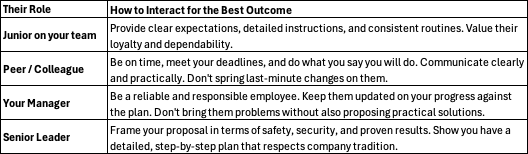
Interacting with The Guardians (SJ Types: ISTJ, ISFJ, ESTJ, ESFJ)
Driven by duty and stability. They are the organisers and protectors of any institution.
-
Positives: Reliable, thorough, practical, loyal. They create stable systems and honor their commitments.
-
Negatives: Can be resistant to change, overly focused on rules, and may not see the big picture.
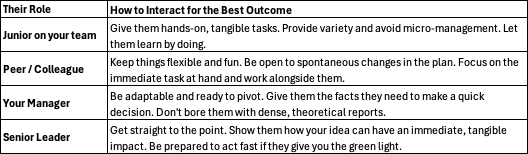
Interacting with The Artisans (SP Types: ISTP, ISFP, ESTP, ESFP)
Driven by freedom and action. They are pragmatic, adaptable, and excellent at navigating the present moment.
-
Positives: Adaptable, resourceful, great in a crisis, fun-loving, hands-on problem-solvers.
-
Negatives: May be impulsive, resist long-term planning, and get bored with routine.
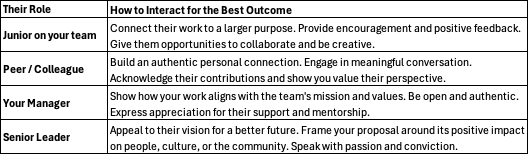
Interacting with The Idealists (NF Types: INFJ, INFP, ENFJ, ENFP)
Driven by meaning and personal growth. They are empathetic, value-driven, and focused on human potential.
-
Positives: Inspiring, compassionate, excellent communicators, committed to their values, see the best in people.
-
Negatives: Can be overly idealistic, sensitive to criticism, and may prioritise harmony over hard truths.
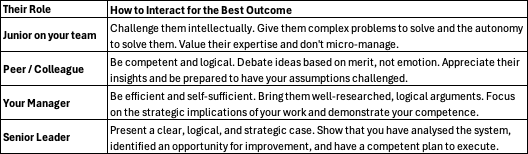
Interacting with The Rationals (NT Types: INTJ, INTP, ENTJ, ENTP)
Driven by competence and logic. They are strategic, innovative, and constantly looking to understand and improve complex systems.
-
Positives: Strategic, objective, innovative, logical, high standards for competence.
-
Negatives: Can seem critical or arrogant, may be insensitive to others' feelings, and can get lost in abstract theories.
Final Thoughts
Learning to spot these MBTI preferences is less about labelling people and more about appreciating the profound diversity in how we think, work, and solve problems.
In your daily interactions, this understanding allows you to move beyond what people do to why they do it. You'll stop being frustrated that a colleague needs every detail before starting (Sensing) and instead learn to provide it upfront. You'll know that to convince a manager who prefers Thinking, you need a logical argument, while a Feeling type will be more moved by the impact on the team. This insight allows you to frame your ideas, requests, and feedback in the language that others are most receptive to, making you a far more persuasive and collaborative team member.
Over the long term, this practice builds a foundation of deep professional respect. Instead of viewing different approaches as difficult or wrong, you begin to see them as complementary strengths. This is the bedrock of innovative and high-performing teams where every cognitive style has a voice. For your career, this is a superpower. It equips you to build bridges between different types of thinkers, lead with greater awareness, and foster an environment of psychological safety. By understanding the unique architecture of your colleagues' minds, you don't just build better products or services—you build stronger, more resilient, and more meaningful professional relationships that will support you for years to come.
If you want to discuss how you can apply what you have read in this article, contact me here and let's make your colleague's love you! Or at least have better, more positive interactions.
Add comment
Comments